international canadian

Wide World View

Archive for the ‘Comparative’ Category

History repeats itself; but that doesn’t mean events are identical

Posted by eMcKean on March 8, 2012

The phrase “history repeating itself” is overused to the point that most seem to not realize how often it actually happens. Anyone with a background in history, whether twentieth century or twelfth, can find recurrences throughout the decades of their studies and into the modern age. That is not to say everything that has once happens will happen again, and it would not be reasonable to monitor every nuance of current events in order to find any measure of similarity with historic ones. However, I cannot fathom how some of the more glaring repetitions are overlooked or ignored. Everything in history is linked, a chain of events that are affected by every action and decision, that effect all actions and decisions. A vicious cycle. Sometimes, newer actions and decisions mirror those of the past, and the events that result are similar. Which begs the question: how do those making the decisions not notice the similarities? These are the people we have charged with our domestic safety and prosperity; we have appointed them as our representatives (at least in the West). To be fair, not all similar events that result from similar decisions are embarrassing or detrimental to a country. Nor are they all glaringly obvious. The article that sparked this particular post was about the difficulties Canada’s conservative government is now facing in its attempt to purchase F-35 fighter jets from the United States. Further reading had me drawing parallel’s to Canada’s AVRO Arrow project in the 1950s.

The Arrow was supposed to be the ‘next best thing’ in fighter jets. The design specifications included specs that had never been seen before, and the Canadian Engineers and A.V. Roe had to invent them. The weapons guidance system was state of the art, and the speed and overall design were innovative. Canadians were proud to be a part of this technological leap, but the St-Laurent Liberals in power had soon realized that the cost was not feasible. But as they decided to wait until after the election to slash to program, the task, and therefore the notoriety, fell to the Conservative Diefenbaker government.

Not only could Canada’s 1950s defence budget not sustain the cost of development, but the United States, whom Canada was counting on as the main customer of the Arrow, was not interested. They had their own fighter jet in development; One that may have not been as technologically advanced or all inclusive as the Arrow, but was nonetheless effective and certainly much more affordable. This coupled with the fact that the Arrow was only designed to destroy high-flying Soviet bombers (a function that was already obsolete with the creation of IBMs) made the ultimate decision to scrap the AVRO Arrow project completely reasonable. In trying to build the most technologically advanced jet of its time, Canada was way out of its financial league.

The modern time parallel is the American’s F-35. In a new era of recession and exorbitant overspending, President Obama has slashed Pentagon spending. The ‘Peace Dividen’ from the ending of the wars in Afghanistan and Iraq. The F-35 in development, originally billed as the ‘Chevrolet of the sky’ has seen much of its funding cut. As a result, its most recent cost estimate sits at $150 million per plane. Even in Washington, the ultimate viability of following through with the original plan to purchase 2,200 of the three variations of the F-35 is in doubt. With the increased cost perspective due to the delay in production, many allies are either reducing their orders for the stealth fighter, or pulling out altogether. Most have shifted their order to the older CF-18 planes to cover the gap between their current fleet’s date of expiry, so to speak, and the new prospective date of the F-35. This has further complicated the issue.

Much like in 1959, the option of another, though not necessarily as good, plane, and the high cost of the better planes has decreased the demand for a state of the art jet that was in financial straights in its own country of production. Neither producing country could, at the time, afford to produce the plane for purely domestic purchase. While in Canada, the result was the total scrapping of the project, in the United States, it has so far merely meant increased delays and funding problems. The crucial difference in this case is that the current allied fleets of CF-18s do not have many more years of use left, even if they are modernized.

While a minor and relatively insignificant historical repetition, the AVRO/F-35 events show that history truly does repeat itself. Leaders should consider this fact when making significant international decisions – most notably, the act of declaring war, or inversely, choosing to ignore the pleas of a people for external interference (Bosnia, Darfur… Soviet Hungary, Syria?). The most crucial concept is that nothing is EXACTLY the same; more like a circus hall of mirrors, projecting a distorted image of the original many times over, in different forms.

Posted in Common Sense?, Comparative, History, North America | 2 Comments »

Oil and Power

Posted by eMcKean on January 18, 2012

With energy being the driving force behind economies since the industrial revolution, and oil being a primary source of that power, the ability to produce and control this resource has become a prominent source of international power in the modern world. Oil became “black gold” when prospectors started striking oil in Texas, and while the term has fallen into disuse, it still applies as a concept. Oil has become power; both for those who have it as a resource and for those who are able to control it as a resource. These are not always the same thing.

In the case of Canada, oil sands in Alberta and Saskatchewan could provide enough oil for domestic and international consumption. Canada sees the successful use of the oil sands as crucial to their ability to ensure domestic economic security in energy. But not all countries are able to maintain control of their own resources when they are so highly sought after.

In contrast, while Kurdistan has one of the largest oil fields covered in that part of the world in history, they are reliant on foreign companies for the exploration and development of oil rigs in the hills and cities as they are the ones able to shoulder the financial risks involved. Politics play both a domestic and international role in Kurdistan. As a semi-autonomous region of Iraq the regional and central governments do not see eye to eye about the contracts to those foreign companies who are looking for a stake. The issue of who will receive the huge profits derived from the oil contracts causes new investors to find negotiations stalled on the stumbling block of Iraqi politics. The Kurds feel vulnerable since the withdrawal of US military forces in the country. The potential of another “Arabization campaign” like that led by Saddam Hussein the late 1980s seems possible because of the huge economic and political power Kurdistan could wield due to the abundance of oil in their territory.

The United States imports the majority of the oil it needs, and thus has strong security interests in the many middle eastern countries that are currently the largest suppliers of oil. Many accused former President George W. Bush of using a falsified claim of “weapons of mass destruction” in Iraq so as to be able to declare war on the country and protect its oil interestes there. There are many actions taken during the war that could support such a claim; the most notable of which is the amount of money and effort spent on protecting the oil pipelines. That is not to say that the protection of those pipelines was not crucial to the national security of Iraq, and thus fell under the United States’ mission statement in that country, but it does force one to consider the possibility that foreign countries can choose to become involved in the domestic and regional issues of others based on their own national interests, and less due to the more altruistic reasons of the protection of democracy and human rights.

But the United States is by no means the only country reliant on foreign oil. Japan and the United Kingdom import the majority of their basic necessities, and oil is no exception. In the case of Japan, four-fifths of their oil imports come from the Persian Gulf countries, and is the second largest buyer of Iranian oil. Where a country gets its foreign oil from has international political implications. The decision to become involved in another country’s domestic politics takes on a more international implication when that country is considered a threat to the ideals of the United Nations. Iran is viewed as a potential nuclear threat, as they have, for years, been openly working on a nuclear program that the West charges is aimed at building weapons. They are also openly defiant of other international norms and agreement. The most recent development has the United States calling for sanctions on the purchase of Iranian oil.

Iran, true to form, reacted with a threat of their own, naval drills in the Straight of Hormuz, where one fifth of the worlds oil passes to get to market. The fear from the point of the Japanese is that the demand that they reduce their dependance on Iranian oil could undermine their economy. A retaliation from Iran could threaten four fifths of their oil imports, which come through the Straight of Hormuz.

What will happen to the economically unstable Iran if the US is able to continue to enforce sanctions of this sort cannot be predicted, but they do have the very threatening bargaining chip of the Straight of Hormuz. That sanctions on the purchase of oil is used as a major international bargaining chip, in which the economies of more than the country at which these sanctions are aimed can be threatened is a pretty clear indication of the international power of oil. It would appear that the best move we could make as a society would be to reduce our reliance on oil at all. I’m sure the major oil conglomerates would have something to say about that.

Posted in Comparative, World | Tagged: , | Leave a Comment »

North and South Korea: a divide not of their making

Posted by eMcKean on January 3, 2012

With the death of Kim Jong-Il on Dec. 17, North Korea is finding itself on the front page of Western newspapers once again. The dictator that had led his country to ruin, starving his populace in favor of participating in a nuclear arms race that was lost to all decades ago, has passed this dynasty to his son. North Korea has only appeared consistently in the news at the times when their nuclear program appears to be reaching success, which has yet to happen, or after another of its border skirmishes with its estranged sibling, South Korea.

The two countries have been almost perperually at war since June 1950 despite a cease fire was signed a little over three years later on 27 July 1953, when North Korea invaded South Korea in an attempt to forcibly unify their recently divided countries. The ensuing war was the first of many inspired by the tensions of the Cold War. The United States was able to ensure the fledgling United Nation’s approval in repelling and then pursuing the North Korean invasion past the 38th parallel (the arbitrary dividing line that the World War Two victors had decided upon amung themselves) only becuase the Russian delegate was abstaining the Security Council votes in protest of Taiwan representing China in the Council.

The division of Korea was a mistake of monumental proportions, still felt to this day. The split was a spillover of sorts; collateral damage from the division of Europe and the fears of the two Great Powers. It was the result of the Russian advance to aid the United States with its war on Japan, the final phase of WWII. But by this time, the US had grown to fear Stalin’s encroaching influence and they ended the war on their own, with the atomic bomb. With Soviet troops in the Korean peninsula, the two major  powers agreed to split the country into two zones, with elections to be held at a later date. When free and fair elections failed, with vary degrees of influence from the occupiers, tensions between the two sides errupted.

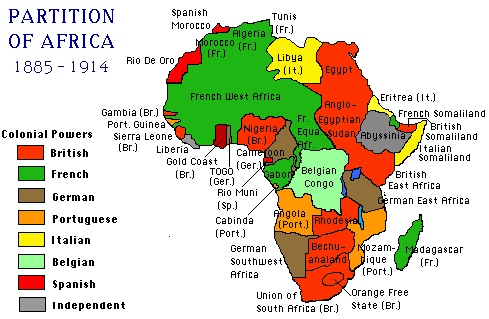
But Korea was not the first country that was thrown into decades of conflict due to a Western desire for control that now takes criticism from Western media. Most of Africa was divided in 1884 at the Berlin Congress by the most powerful countries in Europe. The “great African cake” division held no consideration of the different tribes in the African nation, splitting them along arbitrary lines that best suited the colonizers. The Rwandan genocide is an example of the possible repercussions of such an action. When the Germans had colonized what is now Rwanda in they retained the Tutsi minority population as the leaders, giving them power and authority over the Hutus. Later, the Belgians maintained this power dynamic and exacerbated the divide by issuing separate ID cards to the two tribes and awarding different rights and privileges. The residual anger toward the Tutsi’s added to economic and further political grievances and the Hutus overthrew the monarchy in 1962. Then in 1994, now independent, the country saw the mass slaughter of its Tutsi population by the Hutus.

Historical examples include Vietnam and the Second World War. The terms North and South Vietnam entered common usage when the 1954 Geneva Convention partitioned Vietnam into communist and non-communist sections along the 17th parallel. The Vietnam war was the result of the attempt of Ho Chi Min to reunite the two areas without the influence of the French colonizers. The United States became involed at the behest of their French allies and their own fears of a communist takeover in Vietnam, Cambodia and Laos. Neither of which are a good reason to forcibly divide a country and then proceed to attempt to maintain that division and control through brutal conflict. The outbreak of World War Two can be viewed through the lens of territorial reorganization. The large reductions in German, Austrian and Hungarian territory following the previous war sparked unrest among the populations that Hitler was able to use to his own ends.

How we, as westerners, can sit back and critisize the events in other nations, that the actions of our predecessors helped set in motion decades before, is beyond me. Obviously, all racial and political conflicts are not our fault, nor can each conflict be traced to one source, but past meddleing has cetainly not been beneficial to many nations in documentable history. The death of Kim Jong-Il brings a new chapter to Korean history, but to date, it appears that his son will maintain his father’s policies and method of rule and it would be unlikely that Western media will change its practices either.

Posted in Comparative, North America, World | Leave a Comment »

Canada or Kyoto; which is the flop?

Posted by eMcKean on December 15, 2011

Canada has put itself in a possition of receiving the dubious honour of going down in history as the only country to back out of the Kyoto Protocol after having ratified it. What makes this hitherto unheard of action even worse is that Canada had previously had a “long history in international processes to reduce air pollution and greenhouse gasses (GHGs)” [climatechange.gc.ca, May 2010]. So is Canada’s change in possition on this issue a move away from unreasnable expectations, or a completely pathetic policy failure?

It is clear Canada is trying to claim the unreasonable expectations angle, refering to an ambition gap. The environment minister, Peter Kent, makes it sound as if every Canadian family would go bankrupt if the treaty obligations were met. Perhaps a large burden would have been placed on Canadian households if the Federal government made any effort at all to achieve its emissions reductions, but this is following years of, at best failed attempts, and at worst, total indifference on the part of Canadian policy makers. The large sum of money that has been quoted is purely what would be needed to buy carbon emissions permits to cover the huge overshooting of Canada’s targets. Essentially, Canada withdrew to avoid having to pay for its abject failure.

To make it even worse, if that is at all possible, the recent Canadian decision followed China’s first ever agreement to limits on its emissions. High emitting but not fully industrialized countries, such as China, not being bound by any conditions under the Kyoto Protocol was the most publicized reason for why the United States Senete would not ratify the protocol in 1997. This fact was also mentioned by Canada as a disperity in expectations, but as it no longer holds up, was not used as a significant reason for pulling out.

More proof that Canada is alone on its sinking ship of international travesty is that the countries of the European Union, with higher targets to begin with (8% below 1990 levels to Canada’s 6% target), were already reporting emissions reductions and the adoption of new stretegies in April 2002. In 2005, the European Union Commission Communication reported reductions on a scale that made their Kyoto targets highly likely to be reached. Since then, despite mixed performances domestically, the European Trading System that has been established to monitor their cap-and-trade system has put the Union on a whole on track to beat their Kyoto targets. They will  most likely reach 13% below the target year by 2012. Canada has failed abominably, increasing rather than decreasing their emissions. Yet a Union that has had to coordinate the domestic implementation of any plans for 15 original signatories to the treaty, and those who have joined since the late 1990’s, have managed to surpass their already higher targets.

While Kyoto should not be viewed as the be all end all of international treaties regarding global warming and climate change, Canada has no excuse other than its own lack of reasonable effort to blame for failure. The more pressing issue surrounding Canada’s withdrawal from the treaty is the potential precedent that this action will cause on the international theatre. With the functionality of  international law depending on individual countries coming together to make agreements, and then sticking to them, Canada’s withdrawal from Kyoto, the only ‘binding’ international agreement on GHG emissions, portends more than a carelessness of their impact on the environment. It gives the impression that giving ones word and signing a treaty does not superceed domestic concerns and that when this is the case, ones word and signature are irrelavent to an international accord.

The backlash from this very public action of retraction could spiral into future negotiations as other countries, especially those with less stellar track records in international agreements to date, follow suit. The whole situation reduces my pleasure in holding a Canadian passport.

Posted in Comparative, North America | Tagged: , , , , | Leave a Comment »