North and South Korea: a divide not of their making
Posted by eMcKean on January 3, 2012
With the death of Kim Jong-Il on Dec. 17, North Korea is finding itself on the front page of Western newspapers once again. The dictator that had led his country to ruin, starving his populace in favor of participating in a nuclear arms race that was lost to all decades ago, has passed this dynasty to his son. North Korea has only appeared consistently in the news at the times when their nuclear program appears to be reaching success, which has yet to happen, or after another of its border skirmishes with its estranged sibling, South Korea.
The two countries have been almost perperually at war since June 1950 despite a cease fire was signed a little over three years later on 27 July 1953, when North Korea invaded South Korea in an attempt to forcibly unify their recently divided countries. The ensuing war was the first of many inspired by the tensions of the Cold War. The United States was able to ensure the fledgling United Nation’s approval in repelling and then pursuing the North Korean invasion past the 38th parallel (the arbitrary dividing line that the World War Two victors had decided upon amung themselves) only becuase the Russian delegate was abstaining the Security Council votes in protest of Taiwan representing China in the Council.
The division of Korea was a mistake of monumental proportions, still felt to this day. The split was a spillover of sorts; collateral damage from the division of Europe and the fears of the two Great Powers. It was the result of the Russian advance to aid the United States with its war on Japan, the final phase of WWII. But by this time, the US had grown to fear Stalin’s encroaching influence and they ended the war on their own, with the atomic bomb. With Soviet troops in the Korean peninsula, the two major powers agreed to split the country into two zones, with elections to be held at a later date. When free and fair elections failed, with vary degrees of influence from the occupiers, tensions between the two sides errupted.
But Korea was not the first country that was thrown into decades of conflict due to a Western desire for control that now takes criticism from Western media. 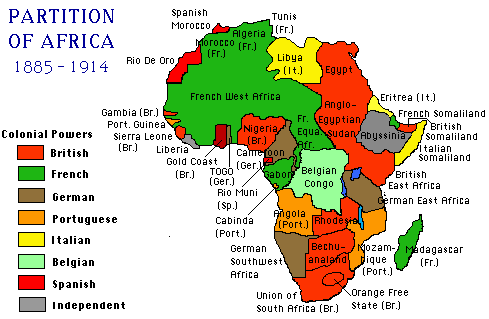 Most of Africa was divided in 1884 at the Berlin Congress by the most powerful countries in Europe. The “great African cake” division held no consideration of the different tribes in the African nation, splitting them along arbitrary lines that best suited the colonizers. The Rwandan genocide is an example of the possible repercussions of such an action. When the Germans had colonized what is now Rwanda in they retained the Tutsi minority population as the leaders, giving them power and authority over the Hutus. Later, the Belgians maintained this power dynamic and exacerbated the divide by issuing separate ID cards to the two tribes and awarding different rights and privileges. The residual anger toward the Tutsi’s added to economic and further political grievances and the Hutus overthrew the monarchy in 1962. Then in 1994, now independent, the country saw the mass slaughter of its Tutsi population by the Hutus.
Historical examples include Vietnam and the Second World War. The terms North and South Vietnam entered common usage when the 1954 Geneva Convention partitioned Vietnam into communist and non-communist sections along the 17th parallel. The Vietnam war was the result of the attempt of Ho Chi Min to reunite the two areas without the influence of the French colonizers. The United States became involed at the behest of their French allies and their own fears of a communist takeover in Vietnam, Cambodia and Laos. Neither of which are a good reason to forcibly divide a country and then proceed to attempt to maintain that division and control through brutal conflict. The outbreak of World War Two can be viewed through the lens of territorial reorganization. The large reductions in German, Austrian and Hungarian territory following the previous war sparked unrest among the populations that Hitler was able to use to his own ends.
How we, as westerners, can sit back and critisize the events in other nations, that the actions of our predecessors helped set in motion decades before, is beyond me. Obviously, all racial and political conflicts are not our fault, nor can each conflict be traced to one source, but past meddleing has cetainly not been beneficial to many nations in documentable history. The death of Kim Jong-Il brings a new chapter to Korean history, but to date, it appears that his son will maintain his father’s policies and method of rule and it would be unlikely that Western media will change its practices either.
 international canadian
Leave a comment